

 Amyah Wright
By: Madison Maynard
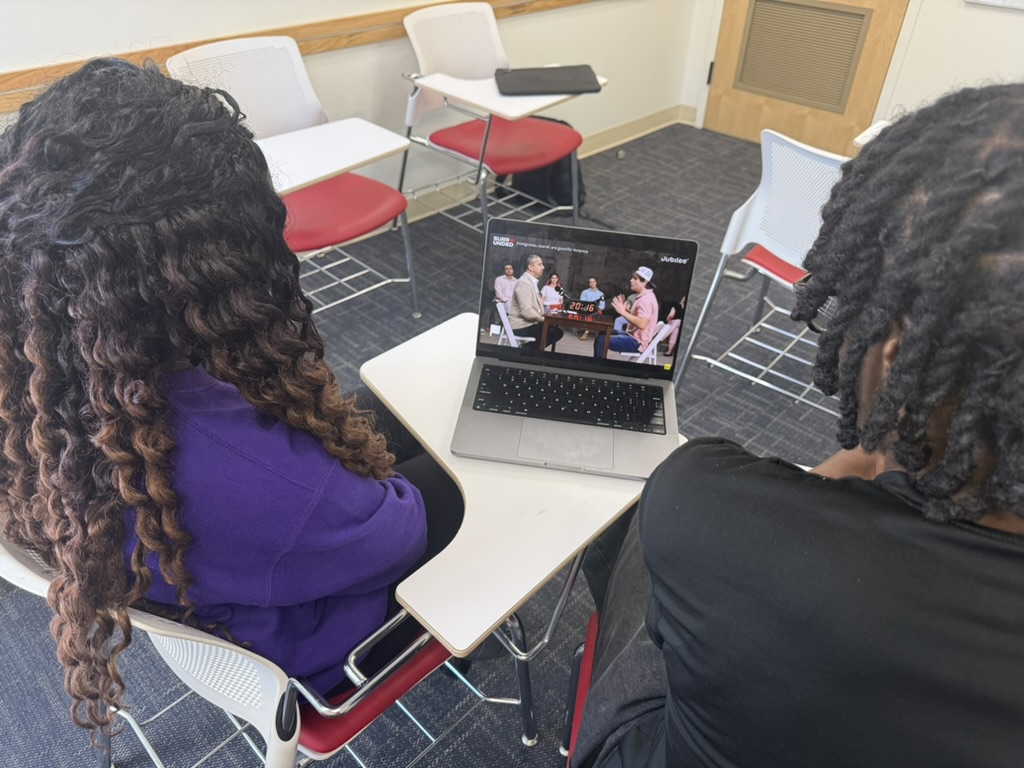
A spectacle. Sensationalizing. Focused on an agenda. Misinformation. Dangerous. All words that consumers of both mainstream media and digital platforms have used to describe the political debates of this era. Viral clips from the popular YouTube channel Jubilee and one of CNN’s most viewed shows on primetime, “Newsnight with Abby Phillip,” can take over our social media feeds, especially for those who are high consumers of this content.
Both Jubilee’s hit online shows,”Surrounded” and “Middle Ground,” and CNN’s “Newsnight with Abby Phillip,” center around political debates with individuals from different ideologies facing each other in a spirited, but often heated, dialogue. But are these debate formats contributing more to our country’s division, specifically when you platform extremist views and hate speech, or are they creating a space for empathy and understanding of one another by eliminating our silos?
Jason Lee of Jubilee and Abby Phillip are saying something entirely different from numerous consumers of this media.
There are numerous examples of controversial episodes on Jubilee. For instance, Jubilee’s “Surrounded,” and its infamous first episode with conservative activist Charlie Kirk where he debated 20 “woke” college students.
He argued that “[Black people] were actually better in the 1940s. It was bad. It was evil. But what happened? Something changed. They committed less crimes.”
Another example is the highly controversial episode, Mehdi Hasan, who founded the media company Zeteo, vs. 20 far-right Republicans episodes, when someone proudly said to Hasan that they were a fascist and “I, frankly, don’t care being called a Nazi at all.”
In Jubilee’s “Middle Ground,” Myron Gaines, a podcast host, was in the episode “fit” people debating “fat” people, where he said that if he were the president of the United States, he would put all fat people in concentration camps.
All of these encounters were viewed by millions of people on YouTube, and easy to assume millions more viewed viral clips on social media. Kirk’s “Surrounded” episode has 44 million views, Hasan’s “Surrounded” episode has 17 million views, and Gaines’ “Middle Ground” episode has 11 million views. In all of these examples, Jubilee is platforming extremism and hate speech.
“[Jubilee] gives a platform to divisive viewpoints… When you platform this, you legitimize what they believe in,” Moriah Gethers, a student at Howard University, argued. “A lot of the comments that they say or that they believe are usually backed by incorrect facts, and a lot of it can also be categorized into hate speech. It gives them a platform to legitimize as ‘yeah this is valid opinion’ and while it is an opinion, where do you cross that line when it becomes hate speech towards someone’s identity or someone’s human rights?”
Elijah Williams, another Howard University student, argued that Jubilee’s priorities seem to be more focused on the entertainment factor than actually bridging the divide, as the ultimate goal is to make a profit.
“Jubilee is thinking like any business or company would, ‘who can we put on our show to get people to tune in?’ It doesn’t matter how outrageous or how wrong people’s beliefs are, but I personally feel Jubilee’s mission is less about politics and more about ‘how can we make good TV?’,” Williams said. “[Jubilee] is willing to bring in all sorts of people that are spewing hatred, spewing racism, prejudice… The only thing they really care about is how many views they are getting and who’s tuning in.”
Elijah Spencer, a Howard University student who did competitive debate in high school, stressed that platforming anti-intellectual rhetoric along with hate speech is incredibly harmful for marginalized communities.
“They’re not there to actually engage in intellectual ideas,” Spencer noted. “Just because they have that opinion doesn’t mean that they should be platformed because they can be extremely dangerous to promote ideas that aren’t founded in reality. [And] I don’t think that these situations create empathy. I think they create more animosity, especially when you’re Hasan, who is a man of Muslim faith, and putting him in an environment with people who actively want him dead. I think that is extremely dangerous.”
Spencer argues that Jubilee fails to create empathy, the digital media organization’s founder, Jason Lee, has frequently expressed that their goal is to “provoke understanding and create human connection.”
In an interview on “Offline with Jon Favreau,” Lee said that their strategy is like “chocolate-covered broccoli,” using an attention-grabbing format to deliver substantive political discourse. But even acknowledging that they use attention-grabbing formats, Lee promised that Jubilee’s ultimate goal is not to be viral or benefit from profit, but they want to provide space for dialogue.
Lee also stressed that having someone on your platform does not mean that you are validating their views, and Jubilee has learned from controversial episodes, such as Mehdi Hasan’s, and didn’t invite many of the participants back on for future episodes.
CNN has turned several Republican and Democratic strategists, former White House officials, and former political campaign staffers into media stars over the years as hired contracted political commentators, such as Ana Navarro, Ashley Allison, Shermichael Singleton and Van Jones.
But the one who has gained the most attention online and praise from the political right is Scott Jennings, a former Bush White House official who has become one of President Trump’s strongest defenders in the media. There have been numerous viral clips of Jennings and other MAGA Republicans that CNN brings on the air debating the liberal panelists on the network’s popular primetime show “CNN Newsnight with Abby Phillip,” with the majority of the time turning into a screaming match and people talking over each other.
“I definitely believe [that CNN] is prioritizing the ratings, because conflict and controversy sells,” stated Jimmy Gilmore, an adult who stopped watching CNN in recent years. “There should be less people trying to push their own personal agendas, let’s not make it personal. Let’s make it about the American people… It’s too much misinformation… and there should be honesty within the messaging.”
Jennifer Clawson, an adult who primarily watches independent media, has an issue with those who identify as MAGA Republicans appearing on mainstream news networks.
“When news outlets have people from the Trump administration or MAGA people in general who didn’t even work in the administration, those news outlets are kind of turning their backs on truth,” Clawson argued. “Because they’re dealing with people to whom facts never mattered and people who just make up things as they go along… so you can’t get any real political substance out of that. I expect more from a broadcast network… they should not be falling to the lowest common denominator because they don’t need to give every crazy person a platform.”
Dionne Jones, an adult who is disillusioned by the current state of political debates, stresses that there is a legitimate other side, but not one that expresses extremist ideology.
“So a legitimate other side is grounded in evidence, is grounded in democratic values, and to me, a genuine policy disagreement,” Jones said. “For example, the differing views on taxation, healthcare models or regulatory approaches. Harmful rhetoric on the other hand, targets people’s identities and spreads this information. So the distinction lies in whether the viewpoint contributes to democratic problem solving or is it going to just undermine the safety and dignity of marginalized groups. So journalism has a responsibility to elevate diverse perspectives without amplifying narratives that endanger people.”
Abby Phillip has defended having MAGA Republicans on her show, arguing on “The Breakfast Club” that you can’t ignore a huge part of the American electorate who supports President Trump, and says that being unaware of what conservatives think is not helpful.
However, many viewers have these concerns when watching political debates, as they believe it’s rarely grounded in fact, and more about expressing harmful remarks that impact the Black community. Drama might make a clip or video go viral, but these kinds of discourse definitely have an impact on the political landscape.
“So when news prioritizes understanding over spectacle, it strengthens the public’s ability to make informed decisions. If people can prioritize understanding over the drama, I think the news and society would be better,” said Jones


 Jada Ingleton

 Kynadi Hyde


 Arthur Cribbs
 Lauryn Forbes

 Shayla Farrow
Recent Comments