
 Briana Outlaw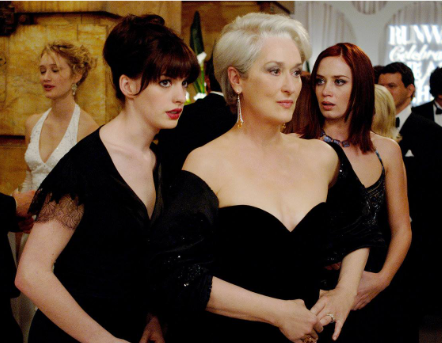
From left: Anne Hathaway, Meryl Streep, and Emily Blunt in “The Devil Wears Prada.” (20th Century Fox)
Most students currently in college were too young to see “The Devil Wears Prada” when it was first released in theaters. We found it later, maybe at high school sleepovers, late-night streaming, or by watching clips online.
At that point, the movie’s quotes were already everywhere in pop culture, and its outfits had made their mark on fashion history.
At first glance, the film looks like a stylish comedy set inside an elite fashion magazine. When you watch it as a college student getting ready to enter a competitive job market, it lands differently. Nearly twenty years later, with a sequel arriving on May 1st, the film feels more relevant than ever.
Beneath the designer clothes and clever dialogue, there’s a deeper story about ambition, power, and the price of chasing success.
The main character, Andy Sachs, starts as an outsider. She’s smart, unsure about fashion, and wants to become a serious journalist. When she gets a job working for editor-in-chief Miranda Priestly, portrayed by Meryl Streep, the position is framed as a stepping stone.
When she questions the job’s significance, her colleague Emily reminds her, “A million girls would kill for this job.”
The story becomes less about clothes and more about hierarchy. Miranda represents professional and institutional power: selective, demanding, and inaccessible. Her approval almost feels like currency. For Andy, being close to that power is both an opportunity and a source of pressure.
As the movie goes on, Andy changes. Her wardrobe shifts first, signaling her growing assimilation into the industry. Soon after, her priorities change.
Her personal relationships strain under the weight of professional demands. Her transformation is gradual, which makes it compelling.
Ambition in “The Devil Wears Prada” doesn’t appear reckless: it appears strategic.
For college students navigating internships, networking events, and early career decisions, that change feels particularly relevant. The pressure to create a resume that signals capability is similar to Andy’s effort to prove she belongs.
In today’s environment, where LinkedIn profiles and digital portfolios serve as first impressions, professional identity is no longer private. It is curated and publicly accessible.
Nearly two decades after its release, the film resonates not simply because of its fashion but because of its portrayal of access.
Who gets invited into elite spaces? What compromises are normalized along the way? How do young professionals define success when validation is tied to how close they are to authority?
With talks of a sequel, more people are discussing the film again, showing that its themes are still relevant. Media and fashion have evolved, especially with the rise of digital influencers and creator culture.
Yet the main struggle, balancing ambition with personal values, remains familiar.
Meryl Streep shared her view on success that feels especially timely for college readers: “The formula of happiness and success is just being yourself, in the most vivid possible way you can.” Her insight emphasizes the decision Andy ultimately makes in the film: choosing authenticity over approval.
For many students on the verge of graduation, “The Devil Wears Prada” is more than a nostalgic rewatch. It’s a case study. It captures the glamour of powerful environments while quietly questioning their cost.
The film stays with us because it shows more than style: it shows what it’s like to step into the working world for the first time. It captures the excitement of being given a real opportunity, but also the pressure that may come with proving you deserve it.
Andy’s experience reflects a moment many young professionals recognize: realizing that the opportunity you worked for can come with unexpected tradeoffs.


 Jada Ingleton
 Kynadi Hyde

 Arthur Cribbs
 Lauryn Forbes
 Shayla Farrow
 Tanaija Kee

 Sydney Goitia-Doran
Recent Comments