
 Trinity Taylor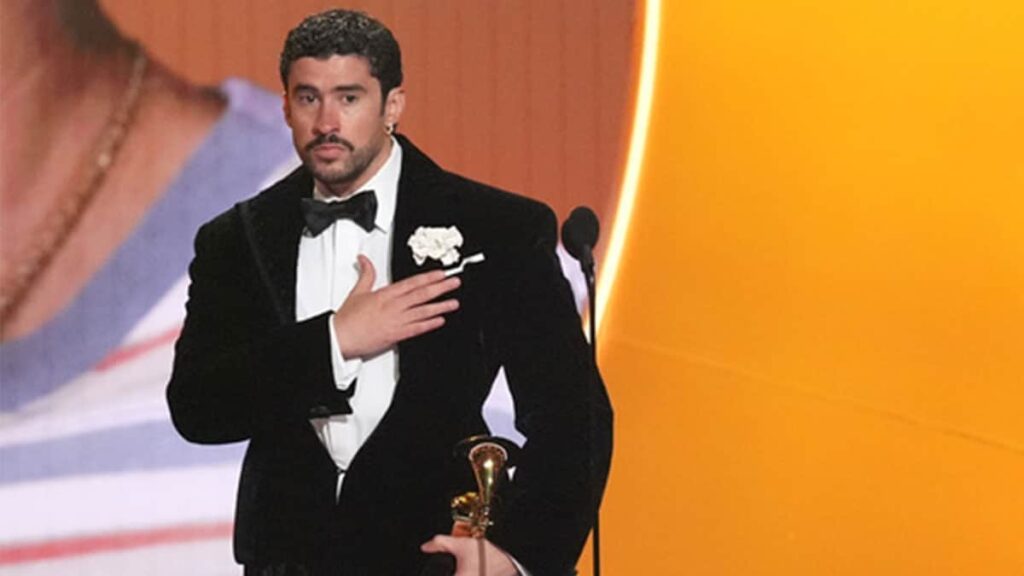
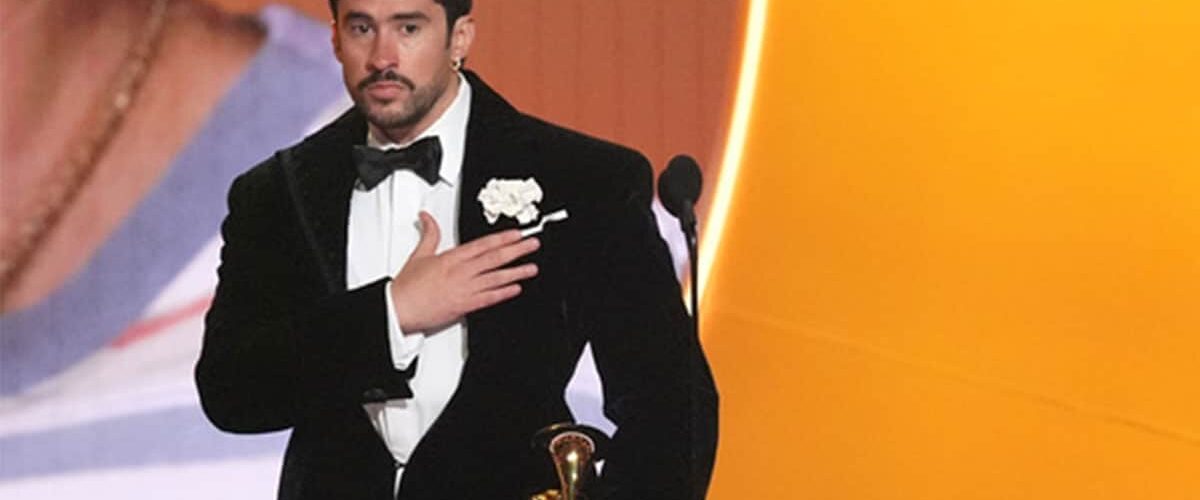
Bad Bunny thanks his fans and heads off the stage at the Grammy’s. (Photo: Billboard)
Nothing about this was an accident. Bad Bunny moved with intention every step of the way, from the grocery store to the Superbowl. And now the world is singing in Spanish. On March 10, 1994, a megastar was born.
Benito Antonio Martínez Ocasio, better known as Bad Bunny, was raised in the Almirante Sur barrio of Vega Baja, Puerto Rico, with his two younger brothers, mother, and father. His mother was an English teacher, and his father a truck driver. Bad Bunny was musically influenced at an early age as he sang in his local Catholic church choir and was constantly consuming salsa, merengue, romantic ballads, and Caribbean sounds, influenced by his parents. Constantly being immersed in music brought him toward an understanding of sound, rhythm, and storytelling that would later define his work.
“I grew up with a lot of love from my mother and my father. I saw them sometimes trying hard, going through difficult times to bring us food, and other times, easy. They were beautiful moments… I was always grateful to the core that I grew up in my family, my barrio, in my pueblo.” (Bad Bunny, Time interview, 2025)
While attending the University of Puerto Rico at Arecibo, Martínez Ocasio worked at a local supermarket and uploaded music to SoundCloud in his free time. The platform became his point of entry into the industry. Songs such as “Diles” and “Soy Peor” gained traction online and circulated rapidly, marking his transition from a local artist to a national presence within Latin trap.
His rise accelerated after he began working with ‘Hear This Music and Rimas Entertainment.” Rather than narrowing his sound for commercial appeal, Bad Bunny expanded it. His releases blended reggaetón, Latin trap, pop, and Caribbean influences, helping push Latin music beyond regional markets and into the center of global pop. Albums like Un Verano Sin Ti and singles such as “Dákiti” demonstrated his ability to achieve mainstream success without abandoning Spanish language or cultural specificity. He remained authentic in the industry and fans, lots of them gravitated towards his authenticity.
As his audience grew, so did his role as a cultural figure. Bad Bunny frequently incorporated themes of Puerto Rican identity, migration, gender expression, and political awareness into his music and public appearances. He used his visibility to emphasize language as a form of power and to challenge expectations placed on Latin artists in American entertainment. His success contributed to a broader shift in how non-English music is marketed and consumed worldwide. You can feel his music without understanding what he is saying, that’s powerful.
That shift became especially visible with his announcement as the headliner for the 2026 Super Bowl LX Halftime Show at Levi’s Stadium in California. The selection marked the first time a male Latin artist would headline the show while performing primarily in Spanish. In interviews, Bad Bunny framed the performance as a tribute to culture, heritage, and the artists who came before him.
The announcement caused widespread attention and debate. Supporters viewed it as a milestone for representation, while critics targeted language, audience reach, etc. The reaction showed that questions about inclusion in mainstream American media still exist, even as audiences continue to diversify.
“I think Bad Bunny is an exceptional choice for the Super Bowl. Not only is it a statement, but it’s also a reminder that being an American is not one particular thing. America is a melting pot and a product of this very performance.” Bashiratu Kanu, a Student at George Mason University.
From working in a supermarket in Puerto Rico to headlining the Super Bowl, Bad Bunny’s career reflects a generational shift in music and identity. His rise illustrates how global pop culture is changing, not through assimilation, but through expansion. The Super Bowl performance is a reflection of his influence.


 Jada Ingleton
 Kynadi Hyde
 Arthur Cribbs
 Lauryn Forbes
 Shayla Farrow
 Amyah Wright
Recent Comments