
 Briana Outlaw
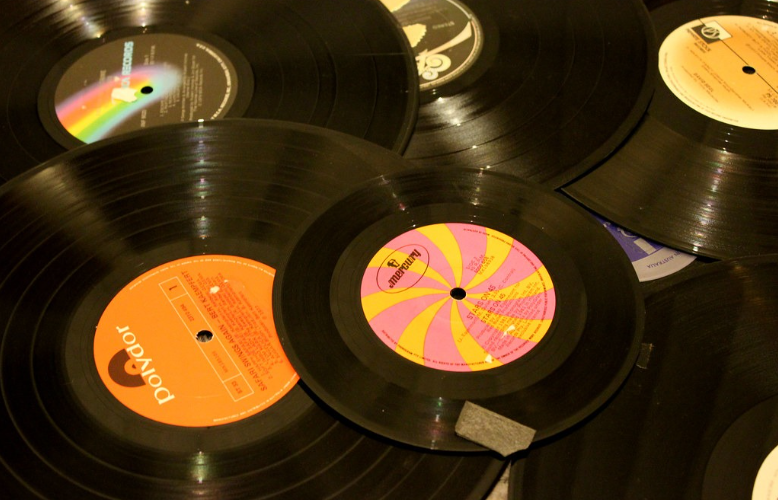
Records lay on top of each other on a table. (Photo: Jamie Curran/Flickr)
The song ends before you’ve settled in. Just as the rhythm starts to feel familiar, it’s over. No extended intro. No instrumental break. Only a hook, a verse, and a quick fade. In the era of streaming and short attention spans, two minutes is now considered enough time to feel something.
Somewhere along the way music stopped lingering. Songs stretching past five or six minutes were produced to slowly unfold, putting trust in listeners to stay present.
Today’s tracks, shaped by playlists and short-form listening culture, are designed to arrive quickly and end sooner. The shift isn’t necessarily about talent or creativity, but about how music is consumed and what the industry now prioritizes.
“Songs aren’t long anymore because people aren’t talented, smart, or musically inclined enough. Music is a business, and it has shifted into the digital era where it’s accessible to everyone,” Jada Lewis, an audio production major at Howard University, said.
“There’s no musical integrity.”
Artists have also acknowledged this pressure. Halsey, an American singer-songwriter, spoke about the industry’s new rules:
“I’ve been in this industry for eight years, and I’ve sold over 165 million records, and my record company is saying that I can’t release [a song] unless they can fake a viral moment on TikTok.”
A reminder that success today is often measured by early social media engagement rather than longevity for the artist.
When a performance is judged in seconds, patience becomes a risk to corporate industry heads
In 1983, The S.O.S. Band released “Tell Me If You Still Care,” a song that runs just under six minutes. Before a lyric is even sung, the record opens with a slow instrumental, allowing the atmosphere to settle before the emotion does. The pacing matches the song’s focus: one rooted in uncertainty and vulnerability. Instead of rushing toward the resolution, the music holds onto the feeling.
Songs like “Tell Me If You Still Care” were structured for patience, where long intros, extended bridges, and instrumental breaks weren’t excessive. They were intentional.
They gave the artists room to build tension, expand on ideas, and let listeners sit with unresolved emotions. The length of these records reflected a listening culture shaped by albums, radio, and communal experience, where staying with a song wasn’t a burden, it was the point.
Today, that expectation has shifted.
Many modern songs introduce vocals almost immediately, shorten emotional arcs, and end quickly to avoid losing listeners mid-scroll. Platforms reward speed, not patience, and music adapts. While shorter songs aren’t inherently shallow, the space to sit in a feeling, to let it stretch and develop, has become increasingly rare.
Listening back to records like “Tell Me If You Still Care” isn’t just about nostalgia. It’s a reminder of what music once allowed itself to be. As Erykah Badu once said, “Music is a form of expression, and that expression should be honest.”
In a culture that moves faster than ever, the question isn’t whether songs need to be six minutes long again.
It’s what we lose when music isn’t given the time to stay.


 Jada Ingleton
 Kynadi Hyde

 Arthur Cribbs
 Lauryn Forbes
 Shayla Farrow
 Amyah Wright
Recent Comments